
Car Emergency Kit: Your Shelter on Four Wheels
Imagine standing in a ten-mile traffic jam on a highway. It's the middle of winter, the temperature is dropping to -10°C, and your navigation has just lost signal. In this situation, your car stops being just a means of transport – it becomes your only shelter.
Many drivers make the mistake of treating their car as an 'indestructible' space that will always get them to their destination. However, in the era of unpredictable weather anomalies, blackouts, or hybrid threats, a car emergency kit is not a whim, but a foundation of safety. Below you will find a list of equipment that will allow you to survive a night in the car or a multi-hour stop in a blocked city.
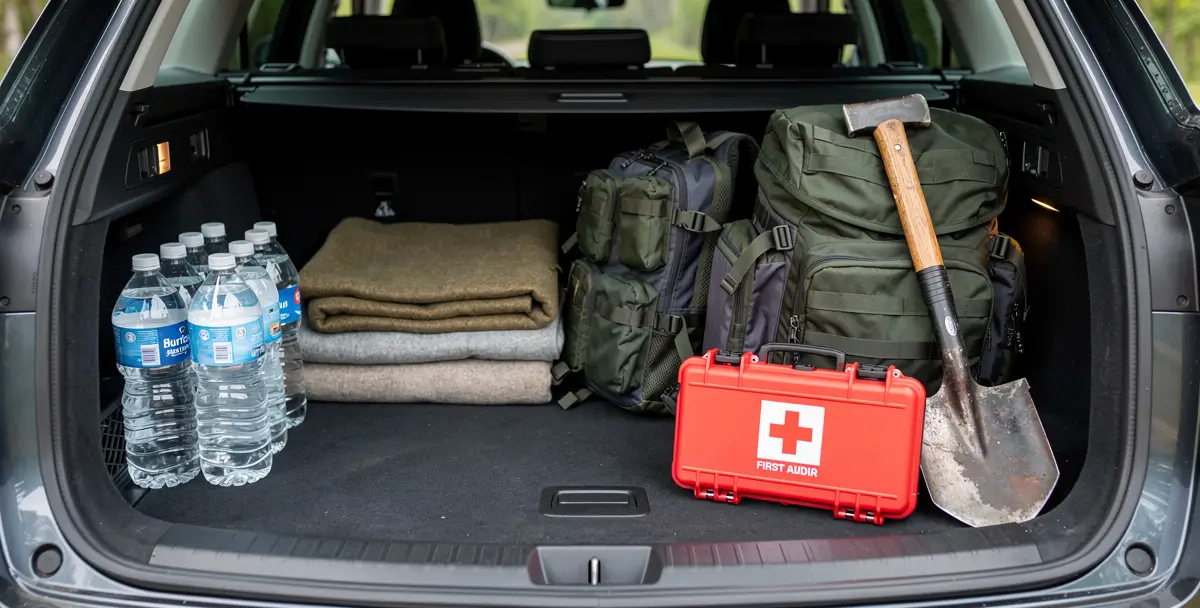
1. Power and Connectivity: When Electronics Fail
In a crisis, a smartphone with a dead battery is just an expensive paperweight. You must have independent sources of energy and information.
- Multi-port Car Charger: Allows charging several devices simultaneously.
- Solid Power Bank: Minimum 20,000 mAh. It's worth having two – a smaller one with you and a larger one as a stationary backup in the car.
- Paper Maps: GPS can be disabled or jammed. A good laminated map can also serve as improvised protection from rain or sun.
- Battery Radio: Car audio will drain the battery in a few hours. A small receiver with shortwave (SW) and longwave (LW) frequencies is your window to the world when the internet fails.
Learn more about how to ensure radio communication during a crisis.
2. Warmth and Sleeping: Comfort is Survival
Hypothermia is your biggest enemy when spending the night in a car. Vehicles lose temperature quickly.
Thermal Equipment
3. Food and Water: Supply Strategy
Not all food is suitable for a car. Extreme temperatures (heat in summer, frost in winter) destroy most products.
- Water in Proper Containers: Avoid PET bottles, which burst when freezing. HDPE canisters are better. Remember not to fill them to the brim – leave space for expanding ice.
- Water Treatment: Chlorine dioxide tablets or a new, dry gravity filter (a used filter bursts after freezing and becomes useless).
- Food: Compressed rations (like Seven Oceans), energy bars, and nuts work best.
Learn more about how to pack a 72H emergency backpack that you can quickly toss into the trunk.
4. Tools and Tech: Rely on Yourself
Before you call for help, try to assess the fault yourself. Sometimes it's just a fuse.
Technical Essentials
5. Financial Security and Procedure
In crisis situations, payment terminals often stop working. Cash in the car (a few hundred in small denominations) is essential.
Lack of Action Procedure
Always follow the STOP procedure: Stop, Take a breath, Observe, Proceed. Do not make chaotic decisions about turning onto unknown forest roads.
Remember: Equipment is only half the battle. You must know how to use it. Test your kit – try preparing a meal on a camping stove or spend a few hours in the car with the engine off.
Frequently Asked Questions
helpWhy shouldn't I fill water canisters to the brim?
Water expands when it freezes. If the canister is full, the ice will burst it. Leaving about 10% free space prevents damage to the container.
helpWhat fire extinguisher is best for a car?
A standard 1 kg extinguisher is usually too small to put out anything beyond a small fire. We recommend having at least a 2 kg extinguisher, preferably powder-based.

